Private data, used without being seen
SCP governs how private data moves from Vault to verified result — through admission, execution, and settlement — without ever exposing plaintext.
Architectural foundations
Symphony
A decentralized privacy data platform for governed ingestion, storage, query, computation, and model training — without exposing user plaintext or forcing central custody.
SCP
The protocol layer. SCP defines what must be true: task lifecycle, semantic model, data protection, settlement, and the economic rules that keep every participant accountable.
SCS
The system layer. SCS realizes SCP guarantees in production through services, storage, APIs, TEE integration, and on-chain settlement contracts on Aptos.
Four task classes. One protocol.
Parse
Single-record interpretation inside one Vault. Extracts structured meaning from raw input without leaving the Vault boundary.
Receipt OCR, document extraction
Query
Governed retrieval across Vaults. Projects query signals without exposing raw records, with minimum cardinality enforcement to prevent re-identification.
Find users who bought coffee in Singapore
Compute
Bounded computation against authorized records. Runs inside Vault or TEE boundaries with auditable execution and settlement-aware outputs.
Eligibility evaluation, feature derivation
Train
Iterative model training across distributed Vaults. Each round is a multi-Vault sub-task; results are aggregated inside TEE without retaining per-Vault outputs.
Consumer behavior model, recommendation engine

A permissioned network, not a central server
SCP runs on a distributed network of Master Nodes, Enterprise Nodes, and End Users. No single party holds everything — protocol finality requires consensus, data stays in Vault boundaries, and every actor is accountable through staking.
Master Nodes
Operated by the Symphony Foundation. Run Admission, Settlement, and Governance. Require BFT agreement from at least 2 of 3 nodes for protocol finality.
Stake: S_master SYM · Fixed membership: 3 nodes
Enterprise Nodes
Approved enterprises that contribute internal data. Operate Vault storage and optionally provide compute capacity. Earn task fee shares when their data is used.
Stake: S_enterprise SYM · Apply through governance
End Users
Data Producers who upload records and Task Submitters who request computation. Data Producers who stake S_producer receive 100% of rewards; unstaked receive 50%.
Not nodes — interact through Master Node APIs
Every task follows a deterministic lifecycle
accepted
Accepted
Task passes admission: identity verified, consent checked, privacy budget reserved, TaskEnvelope assembled.
resolving
Resolving
Semantic meaning is resolved — attributes matched to canonical definitions, query signals projected, Vault targets identified.
dispatched
Dispatched
Execution slices sent to target Vaults. For multi-Vault tasks, each Vault runs independently inside its own privacy boundary.
verifying
Verifying
Results returned and verified. Secure aggregation runs inside TEE. Any party may open a challenge before finality.
awaiting_settlement
Awaiting Settlement
Verified output anchored on Aptos. Rewards calculated for Vault Operators, Executors, Verifiers, and Data Producers.
completed
Completed
Settlement finalized. Rewards distributed. Task evidence chain immutable.
SYM: the protocol's economic backbone
Every task creates an economic event. SYM flows from Task Submitters through protocol-managed smart contracts on Aptos, and distributes to every participant whose contribution made the task possible.
Data Producers who stake S_producer SYM receive 100% of rewards. Unstaked producers receive 50%.
Fixed genesis supply + declining early inflation (8% → 5% → 3% → 1.5% → 0% over 5 years). After bootstrap, all rewards come from task fee redistribution.
Who Pays
- parse
- Free — protocol absorbs cost
- query
- Base fee + per-Vault + per-record + per-epsilon
- compute
- Base fee + compute units + data volume + per-epsilon
- train
- Base fee + per-round compute + aggregation + per-epsilon
Who Earns
- Task fee distribution
- Data Contributors (30–50%), Vault Operators (15–25%), Executors (15–25%), Verifiers (5–10%)
- Data quality rewards
- Data Producers
- Data usage dividends
- Data Producers
- Node operation rewards
- All nodes (bootstrap phase only)
Start here. Follow the path.
01
SCP Protocol Overview
Entry point. Complete mental model in one pass: architecture, task model, data protection, economics, and governance.
02
SCP Core Spec
Normative rules. Task lifecycle states, semantic model, consent and privacy budget, execution, verification, and settlement.
03
Economics & Governance
SYM token mechanics, task pricing, reward distribution, staking, penalties, and governance proposals.
04
SCS System Architecture
How the system is built: deployment topology, service architecture, persistence, TEE integration, and Aptos smart contracts.
05
Use Cases
Three end-to-end walkthroughs showing the protocol in action.
Receipt Upload
User uploads a receipt — parsed, stored in Personal Vault, privacy budget reserved.
Targeted Coupon Campaign
Brand queries across Vaults to find eligible users without seeing their raw records.
Behavior Model Training
Privacy-preserving model training across distributed user data with TEE aggregation.
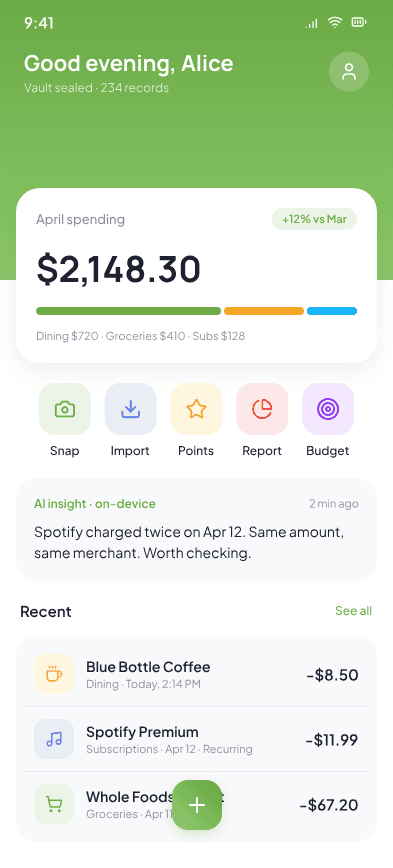
Tacet — the first consumer app on Symphony
A privacy-first AI financial assistant. Your transactions stay in your Vault. AI works for you locally — brands pay you, not a middleman, when your anonymized data powers their research.
Explore Tacet